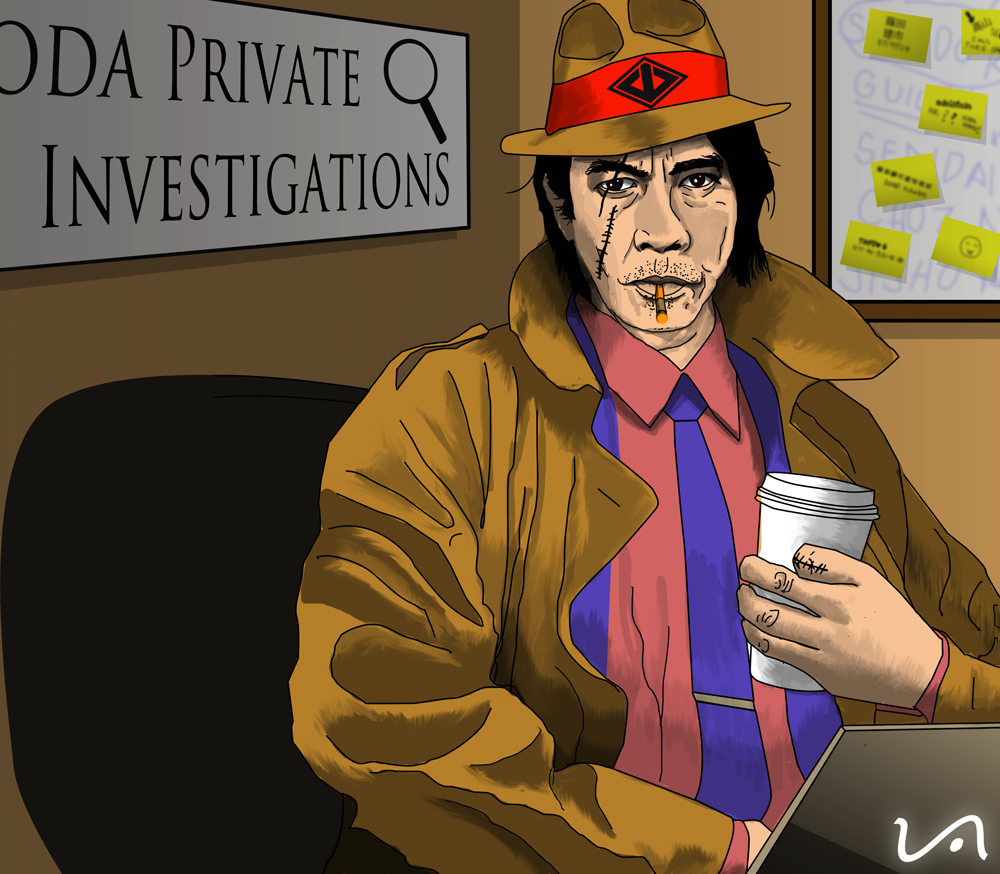
itachi (鼬・いたち): a weasel, but in the yakuza world also slang for a very good police detective. いたちごっこ(itachgokko) “to act like a weasel” refers to a game that Japanese children play in which it is impossible for either side to win. The police versus the yakuza war which has been going on since 1965 is often referred to as itachigokko.
baburu keizai (バブル経済・ばぶるけいざい): Bubble Economy. Japan’s housing bubble during the late 1980s made rich many white-collar yakuza who were doing business in real estate at the time. Some estimates indicate that up to 40 percent of the bad loans left after the bubble collapsed were either directly or indirectly tied to the yakuza.
bakecho (化け調・ばけちょう): A shady private investigation firm, or a supposed corporate investigation that is carried out under fraudulent pretense or with the goal of blackmailing the target, and/or illegally obtaining information for the yakuza or other anti-social forces. Private investigation firms are often used as front companies for the yakuza, and since they also collect information, they are wonderful vehicles for collecting intelligence to extort money from people or silence investigators. Recently (February 2012) the head of the Galu Agency (Yokohama Office), a large private investigation firm with roughly 150 offices across the country, was convicted for fraudulently obtaining the personal records of an organized crime cop. Yakuza Private Eye–it’s a scary combination.
bouryokudanhaijoujoukou aka bouhaijoukou (暴力団排除条項・ぼうりょくだんはいじょじょうこう) : organized crime exclusionary clause. A clause in contract law that makes it easier to cut ties to the yakuza and also possible for the police to easily arrest yakuza who lie about their statues when signing any contractual statement. That simple but effective provision was the brainchild of an anti-yakuza crusader, the late Toshiro Igari 猪狩俊郎先生. A former prosecutor, Igari came up with the idea after consultations with the Westin Hotel in Tokyo, which had had serious problems getting a senior gang boss named Tadamasa Goto to kindly vacate their premises after he had checked in. In fact, the hotel found it had no legal grounds on which to kick him out. After the Westin consulted with him, Igari thought of a way to ensure such problems would henceforth be avoided. The bohaijokou (OCEC) are also included in many contracts, the clause requires signatories to affirm they are not members of any “antisocial forces” — aka yakuza. If they are, but sign anyway, not only can the institution unilaterally invalidate the contract — but yakuza members can be (and now often are) arrested for fraud. 暴力団排除条項 元検事・猪狩俊郎先生が考えた暴力団対策の法的手段。金融界では、銀行取引からヤクザなどを排除するため、金融機関が融資や口座開設などの契約書に盛り込む条項。2008年11月に全国銀行協会が「ひな型」を作り、導入が始まった。契約の当事者や保証人が、暴力団、暴力団員・準構成員、総会屋、暴力団関係企業、企業舎弟などでないことを確約させ、虚偽が判明した場合に取引を解消できる。また、警察当局は契約上に虚偽の情報を入力したことから、詐欺罪で暴力団組員らを逮捕することも可能。11年6月に対象を元暴力団員などにも拡大した。みずほ銀行の問題を受け、全銀協会員行は信販会社との提携ローンを含め同条項の導入徹底を話し合った。
giri (義理・ぎり): debt or obligation. A very complex concept of duty unique to Japanese culture, this indicates both the gratitude one has for an act of kindness and the obligation to carry out revenge. The yakuza distinguish themselves from the American and other mafias by claiming to uphold a sense of giri and ninjo.
hamonjo (破門状・はもんじょう): order for excommunication. Yakuza who excommunicated are no longer allowed to associate with or do business with the group in any form, and are banished from the yakuza world. A hamonjo is said to be reversible, and a punishment that is one step above zetsuen.
kakuseizai (覚醒剤・かくせいざい): speed, amphetamines, meth. The drug of choice in Japan and the trade that has proved more lucrative for the yakuza than even the sex industry. Possibly accounts for up to one-third of total revenue. Virtually the entire business in Japan is run by the yakuza. Slang: (シャブ). Kakuseizai was a legal drug available for many years in Japan and given to Japanese soldiers during the war to keep them working and fighting. Personally, I’ve always felt that some of the Japanese Army war atrocities could be attributed to the fact that they were all high on meth. I call it the “meth-head theory of Japanese war atrocities” It was sold during the war under the brand name ヒロポン (Hiropon), starting in 1941. It has often been said that Hiropon is a play on words: hiro is (疲労-fatigue) and ポン(pon) is the Japanese sound for something bouncing. Thus the idea being that Hiropon would make your “fatigue” simply “fly away.” In fact, it came from the greek word Φιλόπονος which meant “to love working.” As the side-effects of the drug became well-known and the number of addicts grew, it was finally banned in 1951. The yakuza stepped in to fill the gap when production ceased and trade in the drug became one of their early primary sources of revenue.
kigyo shatei (企業舎弟・きぎょうしゃてい): the yakuza associate running a front company. A front company is a fake company set up by the yakuza to appear legitimate and have access to the privileges of running a legitimate operation, while actually engaging in illegal activities/businesses. It’s questionable whether yakuza themselves originally referred to their uninitiated business partners as kigyoshatei but the word has gone from police terminology into the yakuza vocabulary over-time.
kuromaku (黒幕・くろまく): Literally ‘black curtain’. A fixer who works behind the scenes.
marubo (マル暴・まるぼう): yakuza or police who investigate the yakuza. Used by police as a code word for the yakuza, and used by yakuza in reference to investigators. The term originally came from a symbol made by drawing a circle (maru) around the first character of boryokudan in police reporters. Detectives are also called marubo-dekka (マル暴デッカ・まるぼうでっか) and marubo-keiji (マル暴刑事・まるぼうけいじ).
mikameji-ryo (みかじめ料): protection money due on the third day of each month. A type of shobadai.
mizushobai (水商売・みずしょうばい): Literally ‘water business’. A business with a high risk of failure. Often used in reference to bars, nightclubs and prostitution.
rengo (連合・れんごう): federation. A dated suffix for yakuza families. For example, the Sumiyoshi-kai was formerly called the Sumiyoshi-rengo.
sakazukigoto (盃事・さかずきごと): Ceremonial tradition involving the ritual passing of sake to signify a new relationship between two individuals or an individual and a gang. Yakuza are said to, sakazuki wo kawasu (盃を交わす). Ceremonies include succession (・襲名盃・しゅうめいさかずき), linking as parent and child (・親子盃・おやこさかずき), linking as siblings (・兄弟盃・きょうだいさかずき), and fortifying a relationship (・固めの盃・かためのさかずき).
sara-kin (サラ金・さらきん): Short for ‘salary man financiers’. Loan sharks, often with yakuza ties, who lend out at extraordinarily high interest rates. In 1982, about 10,000 borrowers who were not able to their loan back either committed suicide or simply fled their families.
shobadai (ショバ代・所場代): protection money payed by shopkeepers to the yakuza. From an inversion of the word for ‘place’ (basho).
tobashi (飛ばし・とばし): Slang for something fake, typically registered in someone else’s name and used in a scam, such as mobile phones or bank accounts.
yamikin (闇金・やみきん): illegal loan sharks. Typically dole out ultra-high interest loans to those who can’t get a loan legally. Short for yamikinyu.
yubi-tsume (指詰め・ゆびつめ): The act of slicing off a part of the pinky finger to atone for a mistake. This practice has been losing favor recently as yakuza seek to blend in better in the movement toward white collar crime. Also known as enkozume.
zenai kaigi (全愛会議、全日本愛国者団体会議・ぜんにっぽないこくしゃだんたいかいぎ): The All Japan Council of Patriotic Organizations. The largest federation of right-wing groups in Japan, with membership at over 150,000 during the 1960s.
zetsuenjo (絶縁状・ぜつえんじょう): order for irreversible excommunication. Yakuza who are excommunicated in this form are banished from the yakuza world, and any attempt to associate with yakuza will be met with hostility. Zetsuen between two previously associated groups is equivalent to a proclamation of war. Joseki (除籍・じょせき)is simply having your name removed from the yakuza registry and is probably the most benign way of leaving the organization.
Suggestion.
Include the romanized form of each tern for the readers who do not read kanji or kana.
It should also increase access to tht epage from people using Google for some of the terms.
Hi Gilles,
We actually do if you look at the other pages. The anchor tags seem to have mysteriously made the romaji disappear. Will fix. Thanks!
I apologize for the Japanese only link, but the following blog has a fascinating entry about the history of kakuseizai in Japan. It also provides a great example of how the word “itachigokko” is used in context.
http://www.tanken.com/kakusei.html
This is great stuff. Thank you.
No problem. I am glad you appreciated the article. It is the least I could contribute to such an informative piece about commonly used vocabulary in the yakuza world. This may sound like a trivial suggestion, but some people may be interested to know why a section of the pinky finger is sliced off. According to what I have been told by an elder Japanese gentleman who knows his history well, the practice stems back to the Edo period and was intended to make it difficult for individuals to hold a sword.
Very interesting. Extremely few info on that topic in Japan, and even less in English!
Hope to read more some day.
Any specific terms for the Gangs that are specializing in nuclear waste and/or decommissioning?
The billions spent at Fukushima are going somewhere…
There’s a vulgar term for the nuclear political industrial complex: 原発マフィア
Greetings! Very helpful advice in this particular article!
It’s the little changes that will make the greatest changes.
Thanks for sharing!
[…] approfondir vos connaissances: Terminologie Yakuza: http://www.japansubculture.com/resources/yakuza-terminology/ Film: Young Yakuza, 2008, par Jean-Pierre Limosin Article: […]
[…] initiation ritual for a new recruit is a ceremony based around sake, known as sakazukigoto. The initiate sits opposite his oyabun, or “father role,” while the drink is prepared by other […]
“In fact, it came from the greek word Φιλόπονος which meant “to love working.” ” – slight error here in that Φιλόπονος means “to love pain”.
[…] initiation ritual for a new recruit is a ceremony based around sake, known as sakazukigoto. The initiate sits opposite his oyabun, or “father role,” while the drink is prepared by other […]
[…] See on http://www.japansubculture.com […]
Thank you for this very informative article!
Out of curiousity, do you have any info on any specific terms used by yakuza to refer to snitches? Western equivalent would be rats (in the US) and grass (in the UK).
I read somewhere that they call them ‘inu’, however, I don’t know the character used for the word, nor do I have the link to the article I’d read that from anymore. Just wondering if you could help verify the validity of this bit.
犬 (Inu) is often a word used to refer to a snitch. Sometimes, it also seems to be used to refer to cops as well.
Very good. I heard an American actor once say he only knew one Japanese phrase and when he was in Japan he was caught off guard being spoken to in Japanese and responded with the only phrase he knew. Which apparently was a yakuza phrase which was the most serious deadly threat of death. He said it was something that the yakuza only say just before they kill someone. Is this true? And what is the phrase? Thank you